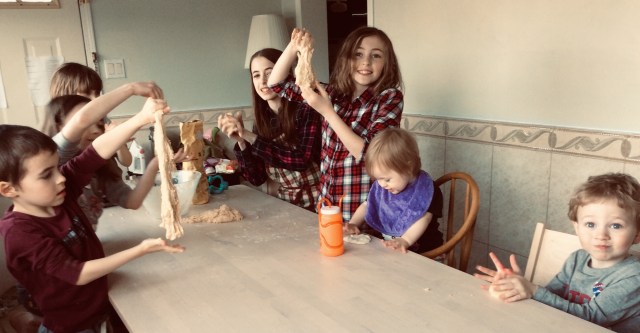
Often when people hear I’ve had eight kids (seven here on earth and one gone ahead), they get wide eyed and exclaim something like,
Oh, how do you do it!? You must be an expert!
I always feel a little awkward, because how do you tell someone you just met,
Actually, I struggle just as much as the next mom…my only expertise could be in making mistakes. I’ve probably made more than most people.
I’m no expert; I’ve had lots of experience with babies and kids, but I’m still learning every day. So I don’t have an expert e-course to offer, or a fancy printable for your fridge, helpful as these things can be. When I share any of my adventures in parenting with you on my blog, it is in the spirit of one friend speaking to another over coffee. I hope we will both laugh and come away encouraged. Maybe you’ll be able to skip making some of the makes I have, or at least to know you’re not alone if you do!
Many things that come to some people a bit more naturally, like being organized or planning ahead, are a huge challenge for me (squirrel!) so lots of the things I’ve learned might be things you already know. Hurrah! You’re doing great.
Homeschool Hacks
- The Myth of Multitasking…Make a Time for Things
Women are often praised for being great multitaskers. It’s true that we often need to juggle many things at once, and can. But is it ideal? Is it actually the best approach? For years I’ve been trying to homeschool the kids, answer the phone, plan activities, cook meals and clean the house at….well, basically the same time. It’s exhausting.
Finally I took an awesome, practical and insightful online homeschool planning course from Pam Barnhill, called: Put Your Homeschool Year on Autopilot. One of the best takeaways for me from this course was the idea of having a basic but flexible schedule so that I wouldn’t always have to be deciding what’s next. I always resisted the perceived constraint of a schedule, but I realize now that having a set time for school to end, for example, means after that, I’m free to do other things…like mark and plan, or cook and clean, without feeling like I should be doing educational activities with the kids at the same time. Relief.
2. Professionals Don’t Pick Up
Another thing that’s been helpful this year, because I’m more clear when is school time, and when is not, is that it’s easier to be more professional about my teaching, and avoid distractions. So I leave my phone and iPad upstairs when we are in session in the school room, and just check messages at lunch and after school. It’s hard for me to resist being always available to everyone who might call or text, but it’s more important that I’m fully present to the kids while we homeschool.
3. There’s no such thing as “just one more thing.”
It’s easy for people to assume that because we homeschool moms are generally home, we are generally available….and therefore free to do them little favours or errands…”just this once,” “just once a week,” “just for an hour,” or whatever. All these little “justs” can completely derail homeschool days. Also, for the busy mom with an ongoing to-do list of 18,264 things, the last “just” could be the straw that breaks the camels back.
I would encourage homeschool moms (actually, any moms) to really mull over any new activities before agreeing to them, and even to consider any current extra obligations: do these things bring you life and joy? Do they fulfill you and make you feel enriched? Great! But if they cause stress, emotional drain, or additional fatigue…then…maybe they just need to go! Quitting some extra’s is not failure; it’s intentionally choosing where to invest your precious and limited energy, so you can give your family your best.
4. Accordion Binders are Magic
As I already mentioned, I’m pretty scatterbrained, and while I have lots of good ideas, I’m also good at forgetting them. And losing things. And wasting time trying to find them again. The dollar store came to the rescue with lovely accordion binders. I got one for each child, so they can easily slip their work into the right labeled slot, and close it up, instead of piling their work on my desk to get lost. Little ones have no trouble with this, the way they often do with using a hole punch and metal ring binder. Also, when our homeschool coach comes to visit, their work should be much easier to find!
I also use a binder for my own projects, such a my second poetry book that I’m slowly compiling and editing. Now my precious papers aren’t lost, and I can grab the whole thing to take with me on rare times I’m out alone and can work on it…even if it’s just on the skytrain.
5. Sticky Notes Save the Day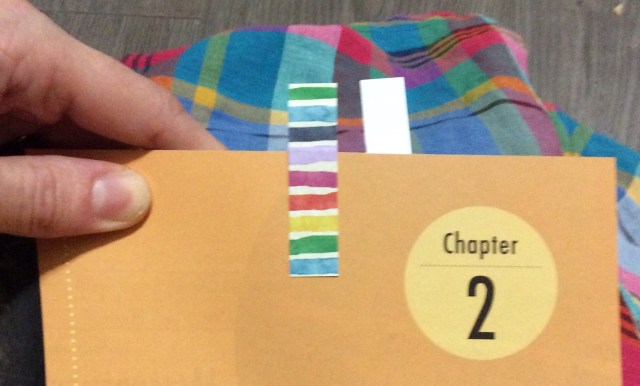
I can’t believe it’s taken me till now to realize how awesome sticky notes are! I got beautiful coloured ones, a different shade for each child, for them to keep their places in the textbooks and workbooks. It makes marking so easy because I know where the kids’ current work is. Sticky notes make their work easy to grab and get started without wasting time trying to remember what we did last and looking for the right page. When you multiply 4 text or work books by 5 kids–considering it takes a minute to find your place if it’s not marked–I figure sticky notes save us at least 20 minutes a day!
When they don’t have mistakes, I move their sticky note forward to the next new page. When there are corrections to be made, I leave it where it is, and move it after marking the next assignment. If we miss a day of a subject, we just look for the note and start again. No problemo.
6. Clipboard Checklists Keep Things Running Smoothly
One of Pam Barnhill’s great tips was to give each child a clip board with a notebook on it, and to write their daily checklist of assignments on it each day. When I take time to do this, usually right after school while the kids have a quiet time show, the next day runs more smoothly. Right away the kids know what’s expected, and can work ahead. If they don’t feel like doing the first one right away, they can also choose to do a different activity on the checklist, knowing they are still getting the day’s work done.
The clipboards are also super handy for filling with any printouts the kids will need that day, as well as additional quiet activities like colouring sheets, mazes or word searches in case they finish before the others. I have a clipboard, too, which I write my basic daily plan on. When I’m writing it, it reminds me to grab all the books I need and stick them in my teacher basket on top of my desk. (You guessed it! Another handy tip from Pam: visualizing your school day to make sure everything you need is at hand.)
7. Plan as if you’re having a new baby
This year, before starting our new homeschool year, I did the same prep I’d usually do if I was expecting a newborn–that is–anything to make life a bit easier! First we delayed starting school for an extra week in order to clean the house. Then my Dad bravely took me on a giant Costco shop (we don’t have a car) and we filled the poor vehicle to the brim with every possible staple, easy school snack, freezable meal, and even some really cool homeschool books and science kits.
I got the toddler, who thinks that she is Van Gogh and every surface is a canvas, a giant erasable-marker ABC book she can lie on the schoolroom carpet and scribble on. I picked up some new alphabet stacker blocks for her, too, and some superman books for her preschool brother, who has a desk and sits with us, too, during school, when he’s not rolling around on the ground wrestling his older brother or attacking people with a sword.
8. Not every meal has to be fancy
Since the kids are often out at extracurricular activities later in the day, my husband had the good idea that we have our main meal at lunch and then do simple sandwiches and fruit, or wraps and veggies, etc, for dinner. This way I can pack sandwiches for kids who will be out, and have them ready for the others who are home. Also, I don’t have to spend the evening doing tons of dishes, because dinner was really simple with minimal mess.
I find I have more energy for cooking mid-day, anyway, and it gives the kids a welcome break mid-school day to go practice music or hang out a bit between lessons. My handy instant pot makes it easy to make things like curry or stew quickly. I save leftovers for my husband’s dinner, and with the kids help, get things cleaned up from lunch before we continue school.
9. Loops are Lovely
One of the other insights tips from Pam’s course was how to use loop schedules. We have basic blocks within which we do certain topics, but they are on a loop. For example, I have a language arts loop, with things like spelling, writing, and grammar, and in that block the kids just do one topic after the other until the time is up, and then start at the next part of the loop next time. There’s no need to feel pressured or behind, or to assign dates to every page…you simply keep swimming! Here’s a list of potential topics for various loops:

This concept of flexible routine is so helpful, kind of like a dancer’s arms: they are firm enough move their own body with them, but supple enough to respond to changes in their partner. Have a plan to ground you, and be flexible enough to smile and give the chocolate pudding covered toddler a bath in the middle of math class! (Math and morning snack always go together for us…but this time was a rather sticky combo!!)
10. Kids Matter Most
All of these plans and tools are meant to serve your family, not to cause stress, if they don’t go exactly as hoped. To paraphrase Todd from The Smiling Homeschooler: Ultimately, curriculum doesn’t matter, your plan doesn’t matter, your schedule doesn’t matter, your kids matter. They are the reason for it all. Watch their faces….little smilo-meters. If they’re generally smiling, you’re doing well. Not that there won’t be challenges each day, but if they’re always frowning, stop and reassess your priorities. Relationship is first.
Todd’s wise wife Donna’s motto is: “If we’ve laughed a little, and learned a little, we’ve accomplished a lot.” I love that! When things go sideways, and kids are too worn out for another lesson, I remember it and pull out the storybooks for a cosy break. Sometimes the unplanned moments create the best memories.
Do you have any favourite homeschool tricks or general teaching tips you’d like to share? I’d love to hear from you!
 Just East Of Crazy Land