Happy New Year and hurrah for “The Happiness Project”!

Lovely readers! How I have missed you all! One New Year’s resolution….to write more often!! To not hesitate to post…to follow inspirations and forget perfectionism. Who knows what good can come from words conceived in joy or sorrow…they are better shared.

There was a gorgeous black and white card I saw when shopping for stocking-stuffers. It was of a little girl wearing fairy wings, standing at the edge of a small precipice. The card read: “But, Mother, what if I fall?” and on the inside, “Oh, my darling, what if you fly?” It almost moved me to tears.  The idea of this daring vulnerability, this willingness to take a creative leap and reach for one’s dreams, despite fear, is to me both brave and beautiful.

I am so excited for the new year–a fresh start and new projects. I have a new poetry book in the works, thanks to the warm encouragement of my mother and sister-in-law who asked me, “So, what’s next?” I realize it gives me great joy to have a project…something to ponder dream about while I am doing the dishes and housework–something to reflect on in quiet moments when I hear the Holy Spirit whispering.So I want to encourage you all to dream big and take lots of little steps each say this year to achieve your dreams…and may this process bring you much happiness!

I am thinking lots about habits and happiness because of a wonderful book my awesome husband got me for Christmas called “The Happiness Project” by Gretchen Rubin. She is a hilarious and warm-hearted New York writer, fiery red-head and mom, so of course I love her! She realized one day that while she was basically content, she could still be snappy, irritable and impatient at times, and didn’t always savour the beautiful moments as they came. How, she wondered, could she be more happy, not by making any dramatic life changes, because she already loved her family and career, but by reflecting on what brought her happiness, what brought her stress and grief, and then trying to build habits that were more conducive to joy. She does this by seeking to change her own habits and attitudes, rather than blaming or resenting others for things she finds hard.

She describes her journey of researching happiness, consulting everyone from psychologists to saints to friends in a café, and then testing out their theories by working on important areas of her life each month, like her home, marriage, parenting and career. This might sound intimidating, but it is quite the opposite. Her frank and funny descriptions of trying out her different monthly resolutions are as fun to read as a novel, and really helpful, too. For example, in February, the month she focussed on her marriage, she tried for a week of “Extreme Nice.” No snapping, dumping, nagging, etc. After describing how positively it affected things at home, she jokes about her relief when the week was up, as her tongue was sore from biting it so often!

She found that personal stories and examples do more for inspiring growth that vague stats and studies. Personally, even reading about her happiness project has made me more aware of savouring my own happiness, and seeking to make it grow. As Rubin reminds us, happier people make those around them happier, so being happy is really the best gift we can give to those around us, because joy is infectious. I so recommend this book to help inspire you to seek happiness this year by building habits of happiness and changing your heart so you can find it more easily. Her blog has tonnes of helpful resources, too. Here is the link: Gretchen Rubin

Happy reading! And have fun with your resolutions…I will write more about that another day!

Small, brilliant humans…


Today I watched  Do schools kill creativity? It’s a great Ted talk by educator Sir Ken Robinson about the nature of education…or even more so about the nature of children. Robinson believes that all children are naturally creative and original, and that the exceptionally bright children wouldn’t be so exceptional if we didn’t spend so much time drilling the creativity our of all the others. Three ways we do this are:

  1. expecting them all to behave the same way in the class room, and almost always diagnosing difference as a condition to be medicated and ‘normalized’. 
  2. instilling a huge fear of making mistakes, which makes creative originality almost impossible, because one has to be willing to risk being wrong in order to do something new. 
  3. focussing so heavily on the academic areas of math and literacy to the exclusion of other areas like dance, drama, music, etc. 

He told an anecdote of a little girl in the thirties who couldn’t sit still in class. She was always fidgeting. Her mother was called in to discuss her trouble at school. After speaking with her and her mother, the teacher, or perhaps it was the principle, asked the mother to step out of the room for a moment with him. Before leaving he switched on the radio. They looked at the little girl through the glass window in the wall. She immediately was on her feet and moving to the beat. 

Your little girl isn’t learning impared. She’s a dancer. Please take her to a dance school.

That was the best advice the mother ever had. Her daughter flourished at the Royal Academy of Ballet, and went on to make millions producing shows like “Cats” and “Phantom of the Opera.” 

And yet we tell kids…don’t bother with music or dance…you can’t make a living at that. Instead we have said for so long, “Be smart and get a degree. Then you’ll be guaranteed a job.” Sir Robinson says we have created a kind of academic inflation, where degrees have become so common that they mean almost nothing, and now a PHD is required for jobs that used to only need a bachelor’s degree. He joked that much as he likes university professors, having previously been one himself, he doesn’t think we are all meant to be professors!

I won’t give away the whole talk…about educating the whole person and not just the head…but you should really watch it because besides being interesting, it is also funny. Being British, Sir Robinson has that fantastic dry sense of humour, and I kept laughing so hard I woke up the baby sleeping on my lap! 

The whole talk made me feel that we need to consciously redefine our view of educating children…that ideas like the blank slate to be filled with ideas, or the small uncultured creature to be civilized are so far off. Perhaps a better definition of kids would be small, brilliant humans, who are unafraid to share their brilliance with others, and with the world. Let’s encourage our kids to keep burning brightly with all their wild and crazy ideas and funny inventions so they that don’t fall into becoming typical adults: large dim humans who are so afraid of making a mistake or displeasing others that they won’t try anything different or new, cause better safe than sorry!


Sleepless Bluegrass Blues

The kids and I recently watched a documentary on Netflix called “Can You Canoe?” about the Okee-Dokee Brothers, musicians who paddled down the Missisppi River and wrote songs. Here’s the link if you’d like to see a preview on ITunes: Can you canoe?

So read this post as a bluegrass song with plenty of twang and a side of lively banjo…

I’m a stranger to the land of sleep

There are foreigners there, whose company I do not keep

And sometimes it’s enough to make me weep

To see the dawn rise upon my open eyes

I’m a stranger to the land of sleep. 

Now there must be, a secret lock and key

Something secure, but hidden from me

A way inside the sleepy isles,

Of that much desired country of sleep. 

So if you know a trick or two

A special drink, or ‘haps some ruby shoes

A certain way, to sleep before the day

Take me along, I’ll travel with you

As a stranger to the land of sleep. 

Little Artist

  
How beautiful to see all the colours that emerge from the hearts and minds of our children—the blurs and smudges that are embraced as expressions of creativity rather than mistakes. If we could paint with the eager brush of children, how much more joyful and alive we would be!

“Mirror, Mirror” and The Lonely Quest For Beauty

In my last post I ranted about a fairy tale movie I disliked, “Into the Woods,” so now I’ll tell you about one I enjoyed a lot. “You’ll like it so much, Mummy,” said my oldest who had watched it before with Daddy, “It was, like, made for you!” The movie is called Mirror, Mirror and stars Julia Roberts as Snow White’s wicked step-mother. But rather than being just another evil old lady movie, Mirror, Mirror takes quite an interesting and humourus look at the problem of beauty. 


The story is told from the perspective of the step-mother, an aging queen who is trying to hang on to the beauty of her youth with all her might. Her most intimate and honest relationship is with her magic mirror; it is the only one permitted to see her vulnerability and insecurity. Time is taking its toll and threatening to snatch away her claim to being “the fairest of them all.” As she has always used her beauty as a source of power, this loss has not only personal but political ramifications, and makes her fearful of losing her crown. 

  
When a handsome (but this time not sleezy like the one in Into the Woods) young prince arrives at the castle, she sees in him an opportunity to solve her financial problems and gain security. The pre-ball ‘beauty treatments’ she undergoes are a painfully funny commentary on woman’s willingness to suffer for her appearance. She uses a a bird-dropping face mask, bee stings on her lips as an instant volumizer, and a horrific harness-like undergarment to squeeze her into her old dress size, to name a few. 

 Yet despite her physical appeal, the queen lacks warmth; she is always determined to feel superior to those she is with, even the prince whose affections she is trying to gain. While she dresses as a magnificent peacock for the costume ball, the outfit she chooses him is that of a rabbit, with silly huge ears sticking out of his hat. It is very clear who is in charge. 

  
 All her efforts at impressing him are trumped by the simple elegance of Snow White, who arrives dressed as a swan, and captivates the prince. The most charming part about her though, rather than her appearance, is how little she thinks of herself. Her defining traits are to be found in her care for others, from the palace servants to the people of her late father’s kingdom. She shines in relationship, rather than in isolation. Integrity and finding the courage to fight for the good are what make this girl attractive. Her Audrey Hepburn-like beauty is something that simply fits with the goodness that exudes from within. 
   
She proves herself a lot more capable than even she expected she was, and finds, with the amusing help of her friends the dwarves, the strength to fight to reclaim the throne of her father from the abusive queen who is taxing the people to death to support her lavish lifestyle. While the young Snow White’s life expands as she gains in her sense of purpose and in serving others, the older queen’s life, built on manipulation and control, collapses inwards as her isolating self-admiration becomes insufficient to ensure her own happiness.   

I highly recommend this movie, for being both humourus and thoughtfully done, and touching on interesting themes of youth, age, beauty, generosity and selfishness. The themes of using beauty as a source of power, and basing one’s self-worth on externals, are certainly important issues facing women in our society today, and worth discussing with our daughters and friends. 

Finally, Mirror, Mirror also ends with an unexpected Bollywood style song and dance number by Snow and the dwarves which is sure to make you laugh! 😄 I sure did!

Movie Rant: “Into the Woods”

I don’t think I’m that hard to please when it comes to movies. I laugh easily, like most things unless they are creepy or offensive, and even enjoy lots of kids family movies.  But not this one! Despite loving the Muppets musicals and being a fan of most fairy tales, I could hardly handle this fairly tale musical, Into the Woods.


The basic recipe was:

  1. Take a whole bunch of fairy tales.
  2. Put them in a blender.
  3. Sing A LOT.
  4. Make it all rhyme. The songs don’t have to make sense as long as they rhyme.
  5. Then, when everyone thinks it’s over, make it an hour longer!

Besides the headache of hearing endlessly rhyming songs sung loudly to a very similar tune, there was the added annoyance of a totally confusing message. At one point Little Red Riding Hood, while plotting to kill a giant, says, “I don’t think my mom would be very proud of me. I’m about to murder someone.” She is reassured by Cinderella, in song of course, not to worry, cause “Your mother isn’t here; you have to make you own decisions now.” So while we hear at one moment that giants are perhaps people, too, and there could even be good giants, we in the next moment witness the ‘good guys’ killing one anyway. Wha!?

Earlier Red Riding Hood is met in the forest by a creepy wolf, who is, unsurprisingly, played by Johnny Depp (please, Johnny, stop playing creepos—you’re too good at it!). He sings about her tender flesh in a way that seems quite unrelated to his belly (yuck!) and she, after being eaten by him and then rescued, pipes away about all she learned…and keeps repeating that it was scary but exciting. What are we supposed to make of that!?

Another “charming” moment is when the sleezy prince woos the baker’s wife, who just had a long awaited baby, by reassuring her that they should  “live in the moment” and that anything goes “in the woods.” This is after he and his brother prince sang of their supposedly heart wrenching love struck “agony” for their newly met beloveds, Cinderella and Rapunzel, while tearing at their shirts at the top of a waterfall. Ugh! 😝 As the prince later explained, “I was raised to be charming, not sincere.” My girls were not impressed. 

Well, anyway, forgive me as this was more of a rant than a review, but in the hopes of sparing precious hours of your life, here is my advice: If anyone invites you Into the Woods, run! 🏃🏻🏃🏻🏃🏻

Into Loving Arms: Rescuing Korea’s Abandoned Babies

IMG_6412

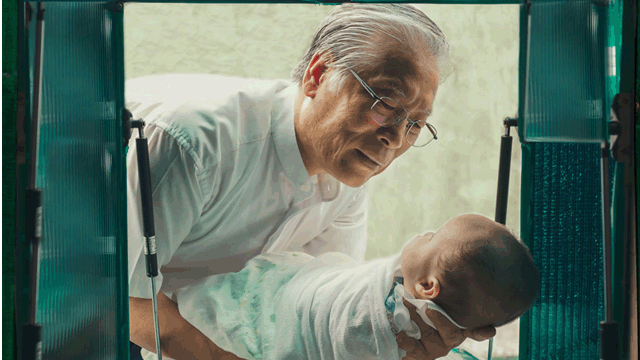
I’ve had the honour of previewing a very beautiful film called “The Drop Box.” It is about a courageous South-Korean man, Pastor Lee Jong-rak, and his loving wife, who care for babies abandoned on the streets of Seoul with a delicacy and tenderness that frequently moved me to tears.

It all began with their son, Eun-man, who was born with extreme physical disabilities. Because their son needed such constant care, Pastor Lee had to sell their house and move into a ward of the hospital with their 6 year old daughter, staying there for 5 years. They soon came to see, by the tenderness he inspired in others and by his ability to smile despite all his physical limitations, that Eun-man was both a gift to them and a teacher about the preciousness of life.

When they moved out of the hospital, other people began to bring them their disabled babies, because they knew Pastor Lee and his wife would care for them. In a society with a very low tolerance for disability or mental illness, their warm acceptance is a rare and special gift to disadvantaged children. Other such babies were being left on the streets after birth, to die in the cold. So to enable people to be able to abandon their babies anonymously, but safely, Pastor Lee made a drop box and installed it in the outer wall of his house.

When a baby is left, a bell sounds and Pastor Lee rushes down to pick up the child. It is so moving to see this older man hurrying down the stairs at 2 am to cradle a strange infant, praying on his knees in thanksgiving for this precious life. This is such generosity. This is such love.

Sometimes the babies are clean and swaddled, other times they still have the cord attached and have just been born. Sometimes they are accompanied by a sad letter from a teenage mother who doesn’t have her family’s support to care for her child…words like, “I’m so sorry. I’m so sorry. Please take care of my baby.”

“When I was naked, you clothed me, when I was hungry, you fed me…as you do to the least of these little ones, so you do unto me.”

Hundreds of babies are saved through the baby box each year. So many little ones who didn’t die abandoned on the cold, hard cement of a back alley. Most go to government agencies to be placed in care, but Pastor Lee and his wife have also adopted many, especially ones with disabilities, and are currently raising, with some help, 15 children. It is worth seeing this gorgeously filmed and beautifully scored movie just to see their happy little smiles, and to rejoice with them in the simple but miraculous gift of being alive.

IMG_6413

They’re not the unnecessary ones in the world.
God sent them here for a purpose.
Pastor Lee Jong-rak

While “The Drop Box” does deal with serious subject matter, it is ultimately a breath of hope in our world which is so often ready to give up on life. Pastor Lee’s humble but firm conviction that every child has a purpose and mission, and that their life—every life— is worth more than the whole world, resounds in my heart.

One lovely example is one of Pastor Lee’s adopted sons who was born missing many parts of his fingers. He struggled against his fear of rejection and ran for class president in his elementary school. To his great surprise, he was elected, twice! He asked his classmates why they voted for him, despite being “a disabled.” “Because you’re good at sports and everything else,” they said, and from then on his memories of being teased and rejected melted away. When he grows up, he wants to take over his father’s work in caring for abandoned babies and children, so all his father’s work isn’t lost, and so he can do more good. The maturity of this child!

I most heartily recommend seeing “The Drop Box,” the inspiring story of the Korean couple who so heroically pour themselves out night and day for the sake of love. As part of the proceeds go to support their amazing work for the most vulnerable—infants in danger of being abandoned—why not spread the word and invite your friends, too? Just click on the heart in the top right corner of the page to access the easy share buttons on the bottom of the page, and send this story to your friends on Twitter, Facebook or Google +. If you’re a follower and receive my posts in your email box, just click on “leave comment” at the bottom of the post and it will take you to my blog site so you can use the share buttons or comment yourself!

Canadian theatre showings will be March 4th and 5th. Here is the trailer to give you a taste!

The Drop Box Film – Award-Winning Documentary About Life

If you feel inspired to donate to help care for the many babies who are left in the drop box, or even to help support a mother in need to be able to keep and care for her baby, please visit the website below. Thank you and God bless you!

Kindred Image

Better by Candlelight

Christmas is coming
The lights are bright
The houses are starting to sparkle

The kids and I
and Grandpa, too
trek across town
to see a Christmas concert
expecting choral beauty
and serene joy

It is….

LOUDBRIGHTGLORIOUS!!!!
FLASHYSPECTACULARWOW!!!
HOLLYWOODBROADWAYLOUD!!!
HALLELUJAHHALLELUJAHHALLELUJAH!!!

…..help!

We leave with ears ringing
and heads spinning
wowed but not wondered
overwhelmed but a little empty

Right now
with my heart a little shaky
I need a gentler kind of joy

The sparkle of a star
the flicker of a candle
that quiet choral music
that seems to be
the breath of angels

In that quiet stable
with the smell of hay
and the donkey
steaming warm air
through his soft nose
I’m more at peace

Away from all the hullabaloo
I reach for that little baby’s hand
the one who is vulnerable
who shares my weakness
who will know tears
but never lose hope

Away from all the bright lights
I’m more ok
Right now
my heart sees better
by candlelight

IMG_5444.JPG

Why Tell Stories Barefoot?

20140626-194330-71010688.jpg

We all come into this world barefoot. We are all essentially the same—the same heart beating, the same little lungs taking their first breath. And the same naked little toes on the end of adorable feet. A unique and unrepeatable person whose features are at the same time wonderfully familiar.

It’s only later that we begin to mask this sameness, to cover it with distinct trappings that say, “I’m me, and not you.” And while it’s so important express our authentic selves, we can take this costuming of ourselves too far. We can fall into thinking that beyond being unique, we are actually superior to some others…”I in my business suit or latest Prada am far too superior to speak to you in ragged jeans…I am in a class above.”

Fashion, finance, culture…so many things we can use to separate ourselves from others, and forget that we are all born into the same human family. We are all born barefoot, and whichever shoes we acquire afterwords are gifts, extras, luxuries, not meant to mask this essential sameness.

So why this meditation on bare feet? Well, it’s because one of the great things that attracted me to the children’s books I’ve just started selling, Barefoot Books, is this beautiful celebration of our world’s cultural diversity, in all its splendid colour and vibrancy. And in celebrating this through traditional children’s stories from people all around the world, Barefoot Books at the same time emphasize the commonality of the human experience.

Whatever our culture, whether we are a rich Norse Queen or a poor African mother walking for miles to buy a cup of flour, we are human; we hope, love, suffer, hunger, and rejoice. We have families, dreams, and stories, and we all need to share them. Our vision of life-—our history, poetry, art and music—all enrich the world and form a part of the splendid tapestry of humanity.

In a world so caught up in superficial differences, I think these tales of diverse cultures are refreshing and important for our children, to help them grow up with a heart that understands that all people are part of the same human family, worthy of our love and respect. So I hope you’ll kick off your shoes and go Barefoot this summer with your kids!

Barefoot Books: Colourful, Cultural Books for Creative Kids

20140627-162656-59216208.jpg

The Girl on Fire Finally Gets Burned

The coals of the firey Hunger Games trilogy are still smouldering on my iPad, several weeks after finishing it. Reading it was an intense experience, and one that made me think a lot. One of the most fascinating aspects was witnessing the slow, sad, mental breakdown of the heroin of the story, Katniss Everdeen. A passionate, intense teenager in a violent, unjust world, she struggles to fight against the repression of her state, and becomes increasingly embroiled in the plans of the rebels to take over from the sadistic President Snow.

For a long time Katniss is increasingly consumed by anger. It takes getting literally burned for her to realize it. That the fire of hatred burns not only the one hated, but the one who hates.

That being willing to do anything to destroy your enemy in fact destroys yourself, because it transforms you into them. That the greatest danger is perhaps not death after all, but losing yourself–what is essential to being you, your best part. It’s like Peeta said before the Hunger Games in book 1, that he wanted to die himself, instead of being corrupted by the Games. He didn’t want to be turned into a killer, a monster, someone willing to do whatever it took to achieve their goal, like the career tributes. At first Katniss can’t understand this way of thinking. All she can focus on is survival, for the sake of her little sister, and unwell mother, for whom she feels responsible.

Later she realizes to her horror, that the deeper into war you get, the more the line between ally and enemy blurs, the more the distinction between right and wrong fades, the more the shining idea of peace gets stained by so many splatters of blood.

In the end, so often betrayed and haunted by so many dead, Katniss trusts no one, and the only peace she can imagine is to join them in the grave, but this idea too gives her nightmares. I’m no expert, but I’m sure she has a bad case of PTSD (post-traumatic-stress-disorder).

Violence consumes her and spits her out broken; she is used as a symbol of rebellion, the Mockingjay, thinking that she is furthering the cause of freedom, when in fact she is helping the advancement if a new dictator, just as willing to kill as the last. When her usefulness expires, and her influence becomes a threat, she becomes expendable, and measures are taken.

The Hunger Games Trilogy beings and ends tragically: with the death of children. The abuse of precious and innocent human life as political bait, as hostages, as gory entertainment, as propaganda, as sacrifice for power, as a means to an end. The end is ugly.

But the books do not end in despair, but return to that small, precious hope of a quiet family life, faithful love, and children, made wiser by our experiences, with a future better than our past.

It reminds me of the return to the Shire at the end of The Lord of the Rings, after all the war and trauma of the journey to destroy the one ring, the ring of power, that nearly consumed Frodo. This ring likely would have killed or totally destroyed him without the faithful friendship of Samwise Gamgee, the kind, generous and brave friend who never abandoned him. After it is all done, and they have succeeded, the most beautiful thing is to see Sam return home to Rosie, to love, a hearth and home, to have a family. This is what makes all the sacrifice and heroism worth it.

Sam and Peeta both show us that what really matters, in worlds that can be so twisted and complex, is to remain true to our essential core, which is unswerving fidelity to those we love, and the realization that love is stronger than death, and is the force which has far more power to save our world than violence.

So what does this mean for us?

That when we are angry, we should seek peace.
That when we are disgusted by someone’s actions, we should still treat them with respect because they are a human being, and we, too, are capable of making many mistakes.
That when we are despised or mocked, we should not spit back nasty words, because returning evil for evil is a sure way to let our enemies win, by turning us into the kind of people whose actions were hurting us in the first place.
That we should never put people in simplistic boxes of good or evil, especially if labelling them the latter dehumanizes them. When we stop treating other people like human beings, we become monsters.

There is an expression worth pondering, that we must drown evil in an abundance of good. Often the best way to make the world a brighter place, instead of lashing out against the darkness, is to let the light of goodness shine by doing many simple, kind, and generous things, and trusting that all these little actions do add up to something important. If we teach this to our children, they can bear little torches of hope out into the world, and touch many lives for the better.

I don’t mean that we shouldn’t fight against injustice, and rally around the oppressed, but when we are in any kind of struggle, let’s remember what the rebels in the Hunger Games forgot: that not only the cause matters, but the way of fighting it, because fighting for a just cause by evil means poisons the whole thing.

And if the idea of violence against children rightly horrifies us, let’s remember that all people, of every background, were once children, too.