Selfishness, Responsibilty and a Blue Couch 


Selfishness is so easy. It’s so easy to focus on yourself and blame all your troubles on others. Doing so allows us to stay in a state of inaction: there is “nothing” we can do about our problems because they are “not our fault.” Someone else is to blame. But this attitude dooms us to shadow-boxing all our lives–flailing out our arms uselessly to hit the imaginary causers of our own difficulties. 

If we are honest with ourselves, we discover that the source of our brokenness is within. Even if we were isolated from all others in a tiny hermitage, we would still struggle. This is a sobering thought. It means we have to rise from our stupor and take responsibility for our lives. Only we can change them for the better. 

But while we can take positive steps towards small changes for the better, healing our brokenness is not something we can do alone. We can’t make ourselves never grumpy, annoyed, snappy, imprudent, lazy or selfish etc by our willpower alone. We are like broken light bulbs whose wires are not connected, so the electricity can’t flow through them. We need to reconnect those wires by joining our hands in prayer, so the grace of God can flow through us and help us to shine. 

In the bustle of daily life, it can be easy to forget this. We get wrapped up in our troubles and forget to ask for help. We forget to pray for our needs, and for the grace to bear hardships cheerfully. But God is just waiting to show us signs of His affection, if we open our hearts to receive it. Sometimes His generosity is very concrete. Recently my Dad and I went on a wild goose chase search for a second-hand dresser for my eldest daughter. We drove all over, even out of town, and checked three stores with no luck.  We saw a couch I liked which could replace our old beat-up red one, but I couldn’t get a-hold of my husband at work to ask his opinion. It was a hot, tiring day and nothing seemed to be quite working. 

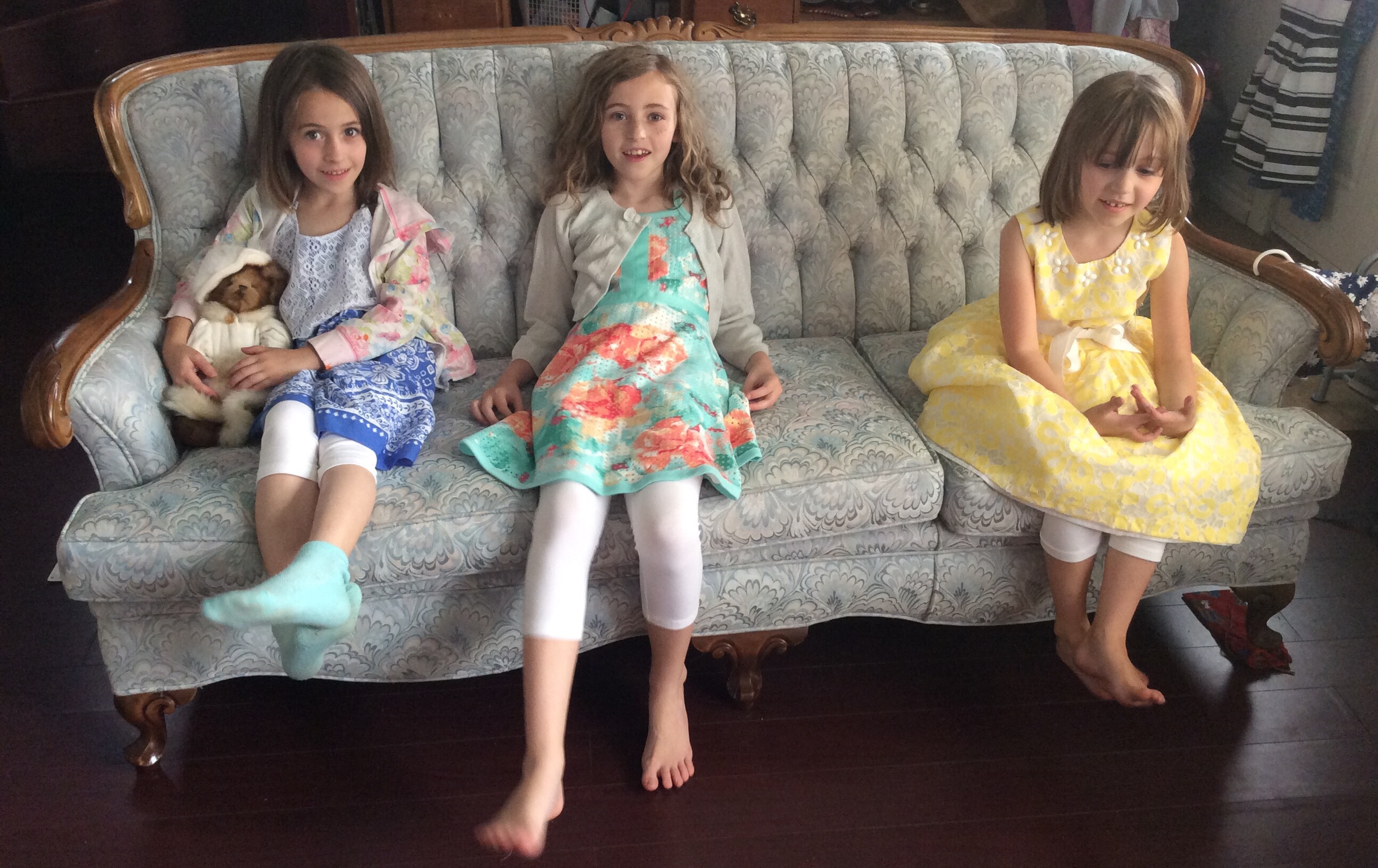
But the next day, the reason for our fruitless search was made clear: there was something  better waiting for us. A block from our house, my Dad spotted an estate sale with gorgeous furniture. There was a beautiful maple dressed in perfect condition for $45. And even more lovely, an antique Coombs couch and matching armchair, with wooden finish and lovely blue upholstery for $250 together. I don’t know what their original price would have been, but the reupholstering alone would have cost $2000 in the ’80’s! Talk about score. Furthermore, they were willing to deliver the furniture to our house, which was another godsend, because some things are just too darn big for my double stroller (we don’t have a car). 

So this is just a little reminder, to myself as much as to anyone else, to take time to join my hands in prayer, reconnect with God and let His love flow through me. If we could all shine our little lights, instead of staying in the darkness of anger and blame, how gorgeous the world would be. Like a glowing Christmas tree, every little light sharing its warmth with the others. In a time of uncertainty and violence, I think the peacefulness of this image is one worth focusing on, hoping and praying for. God bless you all. 

Shining Eyes

At the back of the church

a woman rocks a smiling disabled boy.

Her delight in him–not even her own child–is obvious.


“Look at your smile,” she coos,

wiping his face with a soft rag

in a gesture that is more a caress

than anything else.


All this is not distraction

but divine work.

As the choir sings of the incarnation

and the boy’s eyes shine,

the woman knows she is touching

a piece of Heaven.


Post-Partum and Embracing Imperfection

Today at our parish we had a guest speaker, Georgie, from the  Pacific Postpartum Society. She came to spread awareness about postpartum depression and to give some insights on helping families cope with it. During the presentation, we did an exercise where we compared what “the perfect mother” would do, as opposed to what the real mother would do. “Always be patient and smiling” vs “losing her temper sometimes,” “always making gourmet meals” vs. “ordering pizza or making Kraft dinner sometimes,”keeping the house gorgeous all the time” vs “coping with mess.” You get the idea.

We did this exercise to emphasize the pressures we put on ourselves to be “perfect”– to be “leave it to Beaver moms” who always have a clean apron, a bright smile and freshly baked cookies in our hands. Georgie talked about how our happiness is greatly effected by our expectations, and how far we fall short of them. This is compounded by all the images of seeming perfection we see online, where we only glimpse into people’s lives after they have been edited and airbrushed. Someone joked we need more realistic magazines, like “Mediocre Homes and Gardens.” Recently I saw a funny meme that had a cartoon woman and read “World’s Okayest Mom.”

Why do we keep going after perfection like rats after poison, when we know how miserable it makes us to compare ourselves to others? There are many sayings to help us: “the perfect is the enemy of the good,” “best is good, better is best,” etc. Being gentle with ourselves and humbly accepting where we are at is much more likely to bring peace to our families than striving for unattainable perfection and then beating ourselves up for falling short. As the cleaning guru the Flylady says, “You’re not behind, you’re where you are: now jump in!”

My buddy Monique and I have a “one awesome thing” check-in. We call each other and share the one awesome thing we did that day. It could be anything…that we sent an important email, that we cleaned out the fridge, that we did a cool art or baking project with the kids, that we had tea with a friend who really needed a heart to heart chat, whatever. The point is to focus on the little successes, rather than the long list of “not yet done’s.” As a bonus, the joy of celebrating those little accomplishments is energizing and helps us feel brave enough to try a little more.

Embracing our imperfection allows us to appreciate real life and to accept it, mess and all. And it gives other moms permission to do the same. Rather than wasting time wishing we were like someone else, we can pour our energy into becoming more ourselves, and fulfilling the unique missions we all have. Now that’s beautiful. So next time you wish you were a perfect robot, like Data from “Star Trek: The Next Generation,” remember that for all his intellect and calm demeanor, what made him really special was when he developed the ability to feel emotions. We feel pain, we are weak, we struggle, we laugh, we love–because we are real. And teaching our kids to deal with their real life emotions and direct them towards love is likely the most important thing we will do as parents.

Taking care of ourselves and learning to love ourselves as we are, while always trying to grow better, bit by bit, will be the first step on this journey. Fellow moms, let’s walk it together!


Exactly As You Are: Loving Your Spouse Unconditionally 

Yesterday I wrote a guest post for my friend Bonnie Way on her blog The Koala Mom called “Exactly as you are: Loving your spouse unconditionally.”

Here is her intro and the link in case you’d like to check it out!

Today, contributing writer Anna Eastland is sharing what she learned in a late-night chat with her husband about loving your spouse unconditionally.

No matter how well you know your spouse, every now and then you learn something new, like a new skylight opened and illumined a corner of their soul you hadn’t seen before. You have one of those unexpected midnight conversations where you are allowed to enter an unexplored recess of their heart. How do you respond to this intimate revelation? With love.

Loving Your Spouse Unconditionally
  

“The Wounded Healer” by Henri Nouwen 


Shortly after I lost my baby Josephine in labour nearly 6 months ago, a friend lent me this book by Henri Nouwen: “The Wounded Healer: In our woundedness, we can become a source of life for others.”  The idea expressed in the subtitle caught my attention, because it spoke a truth that I had recently discovered myself…that my pain and brokenness had become a means of connecting deeply with others, and of helping them release their own pain. 

This process is not one of having all the right consoling things to say, or of having found a magic solution to blot out pain. Emotional healing is not about making pain disappear, but about learning how to live with it while maintaining a sense of hope and joy. 

There is a huge difference here, because one involves living in the reality of our broken world, with a hope that transcends it, while the other involves hoping in a world that doesn’t exist in the present…one without any suffering. 

Acceptance or denial, peace or rebellion. Choices we make every day when we live in pain. 

The world may tell us that life is not worth living when there is deep pain, and that the supposed nothingness of death would be better. But I can honestly say that there are things pain does which are very beautiful: 

Pain breaks down barriers between people and connects hearts. 

Pain makes beauty stand out in sharp relief, and helps one appreciate what was previously taken for granted. 

Pain burns away the fear of being authentically yourself, because the petty concern of what others might think ceases to matter as much. 

Pain rips open your heart to let the world in; no longer do you judge those who are struggling. 

Pain makes you rely on God, because your spirit needs support to bear this weight gracefully. Meaning with God’s grace. With prayer. 

Connection. Gratitude. Authenticity. Compassion. Interior growth. These are all pretty big gifts. They make life more beautiful and worth living. 

When you truly suffer, your heart hurts deeply, but loves more deeply as well. And this love, coming from a humble place of pain mingled with hope, can be a source of life for others. 


Walk With An Open Heart


They say don’t judge a man

Until you’ve walked a mile in his shoes,

But I think it goes deeper;

Don’t judge him until you’ve walked in his heart,

A place you can only enter 

By love.


Reveal Yourself and Be Loved

Our deepest fear is that if we reveal our true selves we will be rejected.

Our society encourages this anxiety by bombarding us with tons of glossy magazines claiming to have the secret to perfection: perfect beauty, perfect fitness, perfect diet, perfect relationships.

What message does this send? That if we fail to achieve these things, that’s what we are: failures. Unworthy of attention, unworthy of love.

So we feel the need to cover ourselves in layers of protection: foundation, mascara, blush, lipstick…if we had portable airbrushes we’d likely be constantly glossing ourselves over, too. Like a little magic force field to keep away judgement. (Friends who know I’ve never been much of a makeup girl will hopefully forgive me this cosmetic analogy!) We are afraid that if we let our weakness show through the cracks, we’ll be turned away. Not good enough. Alone.

In fact, this false veneer of perfection forms a wall that keeps others out. The pretence of having no real problems intimidates and alienates others, because everyone has some kind of struggle, and wants to be understood, not judged. Being unwilling to reveal ourselves to others makes us unsafe for others to be honest with us, and blocks the development of authentic friendship, which is based on loving acceptance and trust.

Instead of acknowledging our weaknesses and mistakes, and trying to improve and make amends, we deny them, suppress them, and inadvertently, trap them within ourselves. This makes us feel worse then ever. And carrying all this heavy baggage makes us even more afraid to be discovered. We are haunted by all the skeletons hidden in our closet, if you’ll forgive me the cliché. We become like Scrooge’s partner Marley, who is weighed down by the chains of his guilt for past mistakes. Having never acknowledged his faults and made amends, he is frozen in regret.

I always tell my kids that it’s better to be honest and admit they messed up, than to pretend they didn’t make a mistake. My three year old interprets this in a funny way sometimes:

Me: “Who cut a hole in this?”
Her: “Not me. It was my hand that did it with scissors.”
Me: “Can you please tell your hands not to do this again?”
Her: “It wasn’t the one hand–it was playing Lego–only the other hand.”
Me: “Well, you’re in charge so tell that hand not to do it again.”

It’s natural to deflect the blame, especially when you’re three, but the mature thing is to fess up.

Even though it’s humbling and hard, saying sorry it’s actually very freeing, both for ourselves and the one we apologize to. We can let go of guilt and they of resentment. Truth gives us a fresh start and wipes the slate clean: it is lies that trap us in chains. We have a hard time believing this, because our society can be very harsh and judgemental, and the media loves to glorify the gory details of people’s mistakes. Thank goodness I’m not famous and subject to that!

Sometimes we project our human pettiness onto the divine. We imagine some kind of Zeus waiting in the clouds, ready to zap us if we don’t hide under a bush after making a mistake. But I think this is our biggest mistake–not realizing that we can reveal our true selves and still be loved. That we can always start over again and again, and that the only real failure is giving up on ourselves.

For me, when I apologize after messing up, instead of a thunderbolt, I hear a gentle voice of love. Here’s my interior conversation:

Me: “Hi God. I’m sorry. I messed up again.”
God: “It’s ok, I know.”
Me: “I was trying but…I guess I’m still me, and I just manage to screw things up sometimes.”
God: “I know, and I’m still me, so I still love you.
Me: “Thanks for loving me no matter what. You are amazing.”
God: “And so are you. I made you remember? Don’t give up on yourself. I never have.”

I think if we can rest in the assurance of being loved exactly as we are, we can have the strength and hope to struggle to keep growing, and become even better. This is what true love is, what true friendship is: it inspires us to become the best person we can be. So listen to that cheesy eighties song, and let your true colours come shining through, cause they’re beautiful.

Helping Heroes: 10 Reasons It’s a Good Thing to Accept Help.

20140204-123200.jpg

Accepting help is hard to do for many people…it’s something we need to learn in life, or perhaps relearn after losing our childhood ability to reach out and take a helping hand without shame. Often as grown-ups we feel the need to be a superhero and do it all alone, but aren’t the Avengers much better as a team?

If we can see our fellow human beings as cooperators, instead of competitors, we’ll be a lot more willing to offer and accept help. After all, aren’t we all trying to do our little bit to make the world a better place?

20140204-131017.jpg

It can be hard to swallow our pride and ask for assistance, so here’s ten reasons why it’s good to ask for help:

1. You need it. Come on, no one is perfect. Everybody struggles. To pretend otherwise is to pretend to be a robot. People are much more loveable.

20140204-130239.jpg

2. You give others an opportunity to shine. Let someone else be the hero for once. You don’t need to take all the credit. Everyone has special talents, and getting to use them helps people feel useful and important.

20140204-123328.jpg

3. Being vulnerable enough to ask for help allows others to be honest about themselves with you and deepens friendship. It opens the door for them to ask for help or advice, too. You come to know each other better.

20140204-124712.jpg

4. You teach your kids to do the same. Do you want them to tough it out alone when they really need help, or to know how to lean on others in hard times? They will imitate you in this.

20140204-124025.jpg

5. Doing stuff together is way more fun. Whether it’s a big shopping trip, cleaning the garage, trying a new recipe or artistic endeavour, life is more fun when you have someone to share the load and laugh with.

20140204-125137.jpg

6. You allow others to love you. We all show our love in different ways, but many of us show our affection by acts of kindness and generosity. When we say no to these things, we are saying no to love.

20140204-125419.jpg

7. Accepting help enables you to practice gratitude, which makes your life more beautiful and happy. Moreover, knowing how to accept help gracefully is attractive.

20140204-124212.jpg

8. If it takes a village to raise a child, it also takes one to be a good parent or spouse. Think about this. Becoming the best person you can be doesn’t happen in isolation.

20140204-125732.jpg

9. You’re not alone. There are probably ten people who would drop everything to come help you, if you just asked. When we open our hearts to help from others, we receive so much more than we imagined; unexpected goodness keeps coming when we open this door.

20140204-123758.jpg

10. Cause I said so. So there.

20140204-130926.jpg

Now wasn’t that helpful? 😉